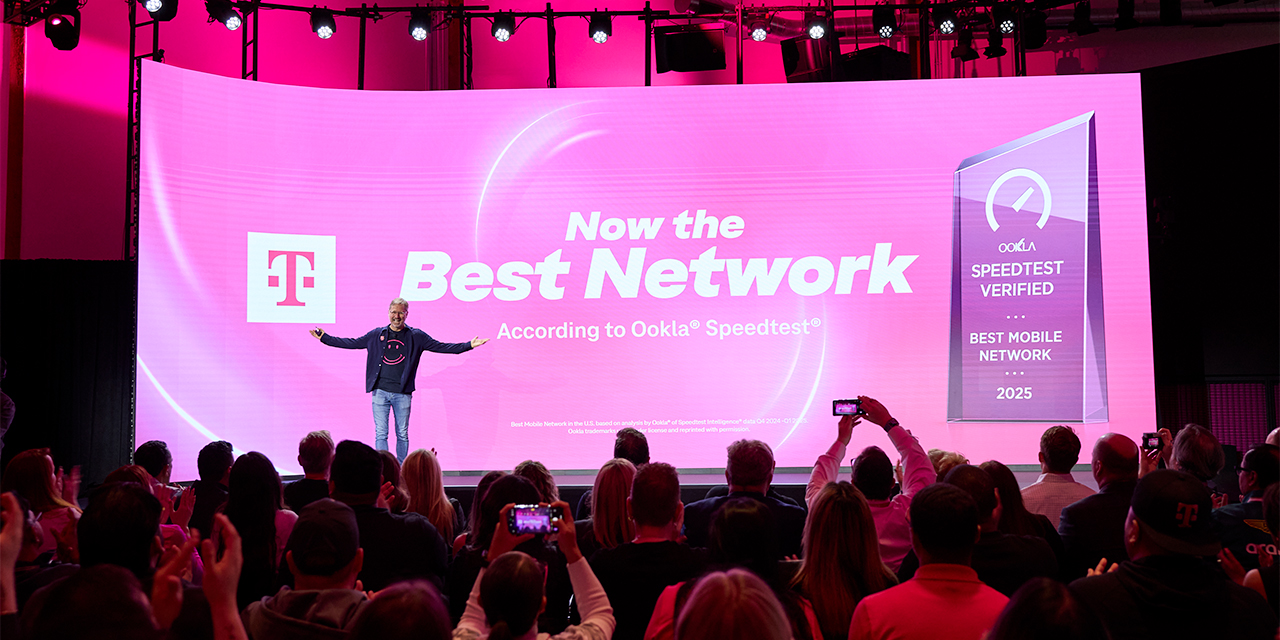
Late last month, in the most comprehensive network test ever conducted in the U.S., T-Mobile was named the Best Mobile Network in America.
If you’ve followed our journey, you know how monumental that is. Back in 2012, we had the worst network in the country. We were losing customers, losing revenue and losing relevance. In the wireless industry, where improvements are typically slow and incremental, our transformation was anything but expected.
But what makes this moment so meaningful isn’t just the outcome, but the journey that got us here.
We Flipped the Industry Playbook
Back in 2013, the top exec from the nation’s best network at the time famously said:
“With unlimited, it’s the physics that breaks it. If you allow unlimited usage, you just run out of gas.”
The typical attitude of the legacy carriers at the time is aptly captured in this comment. Their networks were designed for voice calls, which had a theoretical limit on utilization. There are only so many people and minutes in a day, after all. Modeling, monetizing, and managing the equation was simple.
However, the world was evolving. Quick. Smartphones were starting to become essential. The use of data was skyrocketing. Consumers simply wanted to use their devices without worrying about megabytes or gigabytes.
“How much should we let customers use?” was the question posed by the legacy carriers. “How fast can we build a network that keeps up?” was the question posed by T-Mobile.
Customers Now Write the Rules
Traditional operators had built their networks on a simple equation: restrict supply and charge more for less. Investment strategies aimed to maximize returns by tightly controlling a limited product and charging high prices for it. In the era of voice communication, this worked. Usage was limited. The model was predictable and profitable. That’s why they stuck to it.
However, this model collapsed in the data age. Demand was no longer limited. It was showing exponential growth. Each new application, screen, and service was adding another layer of usage. Customers didn’t want restrictions. They wanted freedom. Unlimited access. Everyplace.
That’s exactly why Un-carrier did just that. Our customers told us what they needed, and we figured out how to do it. So, how did we achieve what the biggest and most successful operators of that time deemed impossible?
Instead of charging more for less, we focused on delivering more with less. Instead of asking, “How much can we make per gigabyte?” we asked, “How can we deliver each gigabyte more efficiently?”
This single change in thinking changed everything and became the heart of our entire Un-carrier strategy.
A 5G Fork in the Road: Once-in-a-Generation Opportunity To Leapfrog Into Leadership
Our strategic difference became most apparent in the early days of 5G.
Traditional operators faced new generation network technology, but they responded with an old strategy.
Probably by looking at the usage on their own networks, they saw heavy traffic at a few hotspots. However, these usage signals were not organic; they were filtered by the limitations they imposed themselves. Therefore, they made a wrong bet on a technology that focused on the “millimeter wave” radio spectrum, which is fast but limited, expensive, and difficult to scale. And they tried to charge a high price for it.
We saw something different. We saw 5G not as a reason to revisit old models, but as an opportunity to create a new model.
At this point, we had already redefined how to scale a network: reducing cost per bit, efficiently meeting increasing demand, and investing not just in speed pockets but in width. A multi-layered network focused on mid-band spectrum, rather than millimeter wave spectrum, would make this possible.
Therefore, we have achieved an unprecedented merger with Sprint, the largest owner of mid-band spectrum. The Sprint merger unlocked massive mid-band spectrum assets to take our approach to the next level. Suddenly, the philosophy we proved in 4G has gained the scale, efficiency, and momentum to permanently change how networks are built.
This was a better approach not just for T-Mobile customers, but for all wireless customers, because the rest of the industry is now trying to follow our lead. Today, the mid-band-centric and multi-layered 5G network pioneered by T-Mobile is the envy of the 5G world. Widely imitated, but never fully replicated. Our competitors have spent tens of billions of dollars trying, but they still haven’t caught up to T-Mobile’s multi-year leadership in 5G spectrum deployment, macro cell site density, and advanced 5G technologies designed to deliver more performance from every capital dollar and every spectrum slice.
Result? A better-connected world and T-Mobile customers, the ones with the best connection.
From Catching Up to Setting the Pace: Moving More Data per Day Than We Did per Year, Just a Decade Ago
Since 2012, we’ve invested nearly $200 billion into our network, business and spectrum. And today, our network moves more data in a single day than it did in all of 2012. Typical 5G speeds on our network, the fastest in the USA by far, now rival wired home broadband speeds and are actually faster than the Wi-Fi that customers experience the majority of places they go. And with T-Satellite launching this month, we’ll begin covering the 500,000 square miles no wireless network reaches today (that’s the size of California, Texas and Florida combined!).
Customers made it clear what they wanted. And T-Mobile network leadership didn’t happen because we were smarter. It happened because we listened — and our team found a way to make it happen. This culture of listening and responding with humility, relentlessly pursuing our goals, and never settling is what I believe is our biggest competitive advantage — an advantage I spend most of my time trying to reinforce, and the reason I believe we’ll stay ahead for years to come.
Our mission is simple: to be the best in the world at connecting customers to their world.
That mission constantly pushes us forward — whether that means redefining what a wireless provider does, or finding new ways to solve old problems. We’ve made truly historic progress, but if there’s one thing our customers remind us of every day, it is that this work is never finished.
Therefore … (wait for it) … We Won’t Stop!
Read our other articles by clicking HERE